I grew up professionally at a consulting firm. I started as an entry-level consultant and worked my way up to a seat on the leadership team through my performance as a consultant, a team lead, and a client partner. I knew the company, the clients, and the culture.
Moving into an executive role felt like a natural next step, and I expected it to be an expansion of what I was already doing. In reality, it required a shift in context, mindset, and skills.
Instead of focusing on my team, my clients, and my projects, I was responsible for what was best for the firm. That meant balancing long-term strategy with near-term realities, sharing my point of view more assertively, and communicating more clearly across the organization and market. It also required a much deeper understanding of the financial and operational levers behind firm performance.
What Changes When You Join the Leadership Team?
I didn't fully understand this transition until I started coaching professional services executives.
Most new leadership team members are promoted because their department performs. They built a strong team, delivered for clients, and hit their numbers. Those are the right reasons to promote someone.
But the role they step into asks a different question. It's no longer just "What does my team need?" It's also "What does the firm need?" Sometimes those answers line up, but often they don't.
In some cases, these leaders simply haven't been exposed to all sides of the business yet. When you're leading a delivery team, you may not have exposure to the firm's P&L, the pricing model, or the trade-offs behind the strategic plan. If you're leading a sales team, you may not have seen how utilization and delivery capacity shape what the firm can take on. Your old role didn't require that level of exposure, but the new one does.
How the Gap Shows Up, from Both Seats
This transition looks different depending on where you sit.
IF YOU’RE NEW TO THE LEADERSHIP TEAM
You may notice:
You advocate hard for your team, and it can come across as protecting your team rather than solving for the firm.
You report on your goals, but they don't clearly connect to what your peers are working on.
Conversations about margin, utilization, or pricing move quickly, and it's not always clear how the pieces fit together.
You hold back your opinion on topics outside your function, even when you have a useful perspective.
You sense the leadership team isn't fully aligned on the strategy or values, but you're not sure it's your place to say so.
Clients still see you as the expert in your area, and you're not sure how to speak for the rest of the firm.
IF YOU’RE THE CEO
You may notice:
Leadership meetings feel like a negotiation between department heads instead of a conversation about the firm.
You're still the only one holding the firm-wide view, so every trade-off routes back to you.
You expected the promotion to take work off your plate, but the accountability still rests with you.
Your newest leaders are strong in their lane but tentative on firm-level decisions.
You're not sure how to develop them, because what they need now is different from what got them promoted.
This doesn't mean the promotion was a mistake. The leader is in the middle of a transition, and most firms leave them to figure it out on their own.
The Four Shifts from Team Leader to Firm Leader
Moving from leading a team to helping lead the firm requires four shifts.
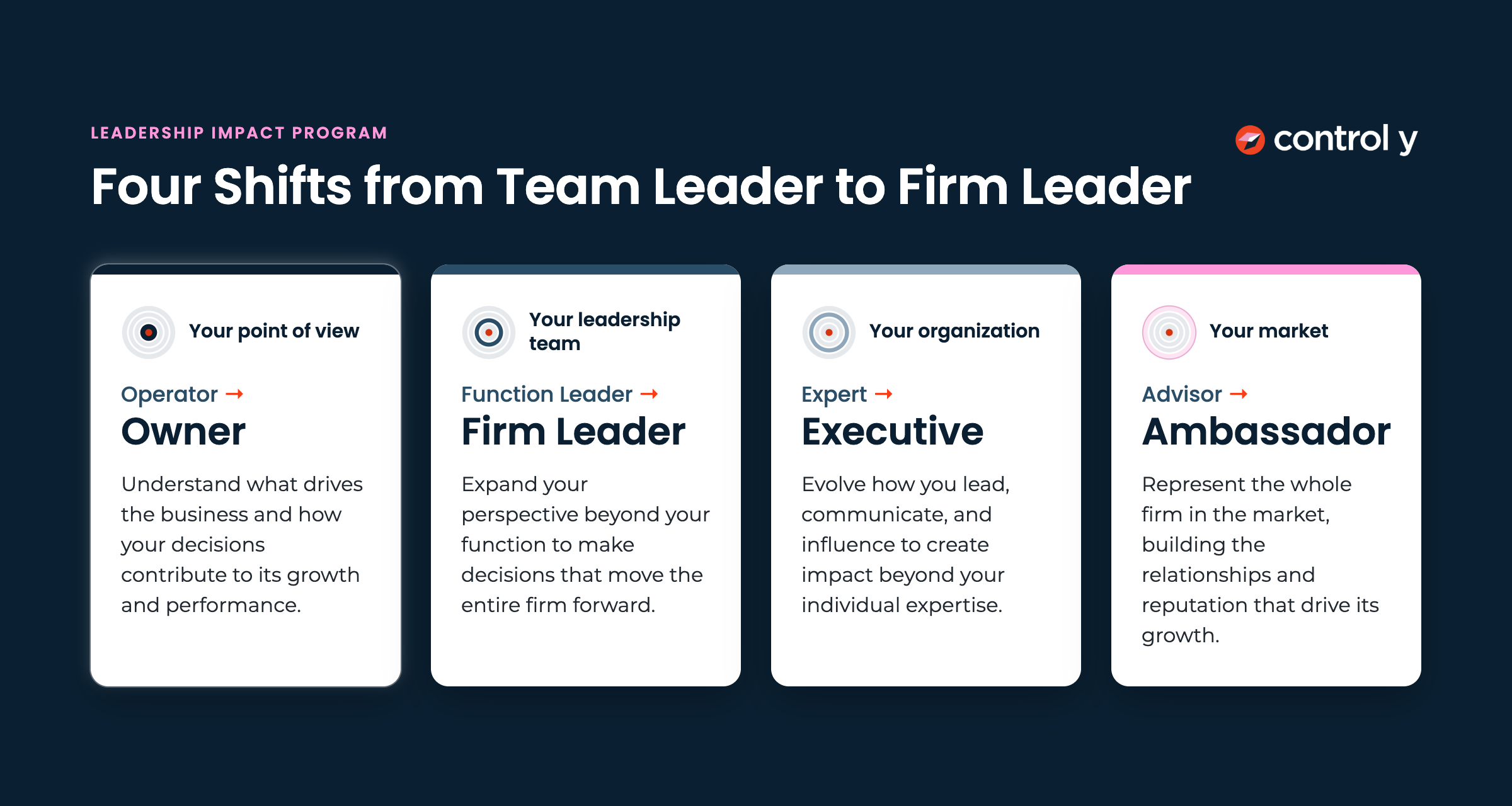
Operator → Owner: Understand what drives the business and how your decisions contribute to its growth and performance. Owners know the financial levers, how capacity and demand drive utilization, and how daily decisions show up in business results.
Function Leader → Firm Leader: Expand your view beyond your function to make decisions that move the entire firm forward. That means connecting your team's goals to firm priorities, weighing short-term results against long-term growth, and seeing the ripple effects of cross-functional decisions.
Expert → Executive: Evolve how you lead, communicate, and influence to create impact beyond your individual expertise. Executives communicate vision and strategy clearly, build alignment in the organization, and use feedback to create a culture of accountability.
Advisor → Ambassador: Represent the whole firm in the market, building the relationships and reputation that drive its growth. Ambassadors connect clients to expertise across the firm, build strategic relationships, and bring market insight back to firm strategy.
For CEOs, these four shifts offer a shared language for what success on the leadership team looks like. Intentionally focusing on development in each of these areas helps new leaders grow into the role faster.
How the Shifts Happen: Point of Impact
So how do leaders actually make these shifts? It takes a combination of context, mindset, and skills. I think about it as a target. Your point of view sits at the center, and each ring expands your impact.
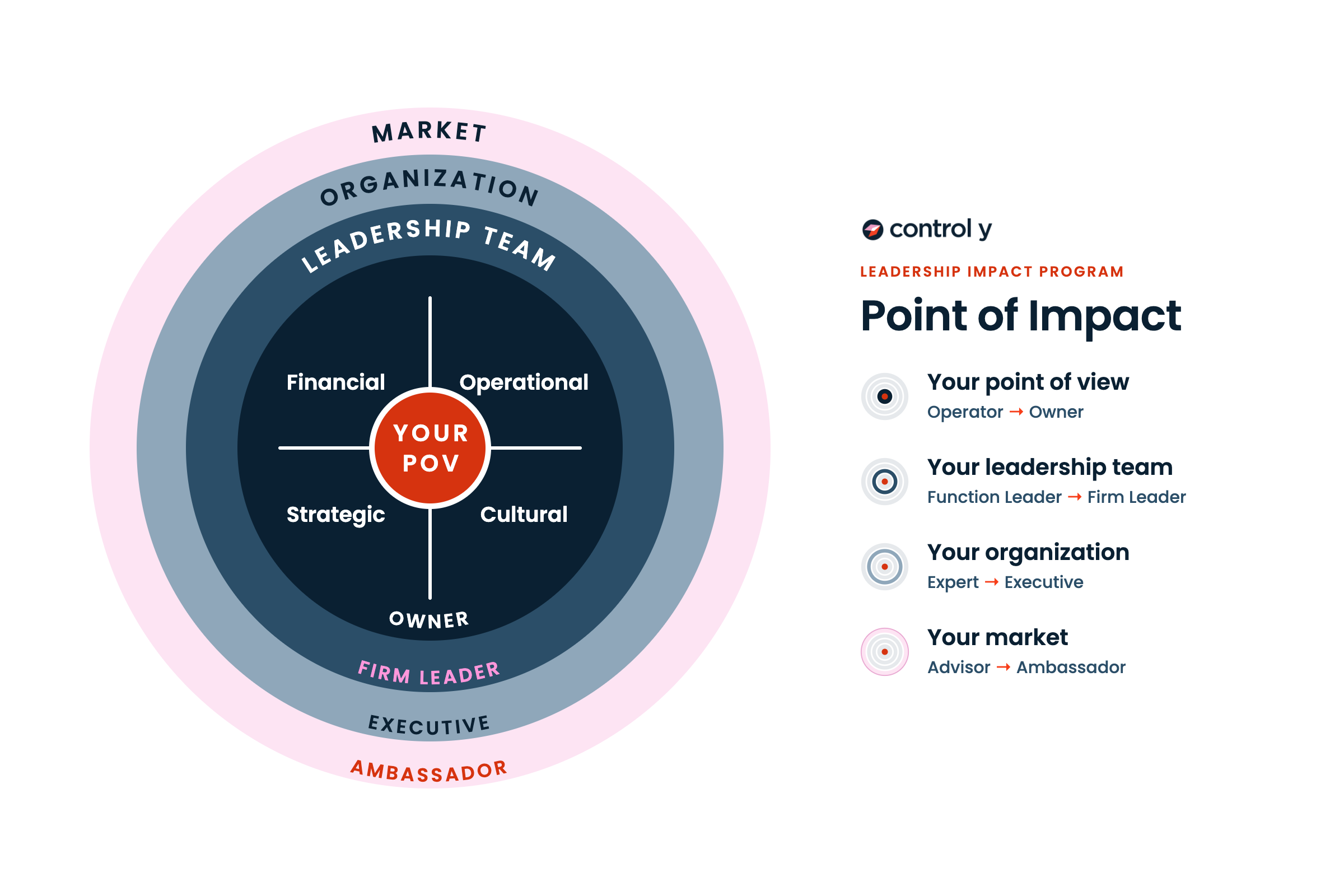
It starts with your point of view. At the center is how you see the business: financially, operationally, strategically, and culturally. Most leaders arrive with a strong view in one or two of these areas, shaped by the role they came from. A delivery leader may see the firm through utilization. A sales leader may see it through pipeline. Broadening that view is the Operator → Owner shift.
Next is how you make decisions with the leadership team. Leadership team decisions are rarely right versus wrong. They're polarities to balance: near term and long term, my team and the firm, strategic and tactical. Bringing a firm-wide point of view into those conversations is the Function Leader → Firm Leader shift.
Then comes how you lead the broader organization. Once a decision is made, your job is to communicate it clearly, own it even if you argued for something else, and bring your team along. That's the Expert → Executive shift.
Finally, how you show up in the market. Clients and partners now see you as a leader of the firm, not just an expert in your area. Representing the firm's full set of capabilities and bringing what you hear back to the leadership team is the Advisor → Ambassador shift.
Each layer builds on the one before it. When you can only see part of the picture, it's hard to influence the decision, and even harder to lead your team through it.
Where to Start
You don't need a formal program to begin making these shifts. Start with a few questions:
IF YOU’RE NEW TO THE LEADERSHIP TEAM
Operator → Owner: What are the biggest financial and operational levers for the firm, and how do they connect to my function?
Function Leader → Firm Leader: When do I find myself trying to "win" for my team in a leadership discussion, instead of solving for the firm?
Expert → Executive: Where am I holding back my point of view?
Advisor → Ambassador: When I talk with clients, how often do I connect them to expertise beyond my own area?
IF YOU’RE A CEO WHO JUST PROMOTED FROM WITHIN
Operator → Owner: What context about the firm's finances and operations have I not shared with my new leader yet?
Function Leader → Firm Leader: Have I been clear that their job is now to solve for the firm, not just their team?
Expert → Executive: Where can I invite them to weigh in on decisions outside their function?
Advisor → Ambassador: Where could my new leader represent the firm with clients, partners, or the community?
LEADERSHIP IMPACT PROGRAM
Ready to Expand Your Leadership Impact?
Joining the leadership team is a big transition, and most leaders make it without much support. That's why I created the Leadership Impact Program, a 12-month executive accelerator for professional services leaders who have joined their firm's leadership team in the past three years, or will in the next year. It pairs quarterly peer workshops with one-on-one executive coaching, built around these four shifts.
For CEOs, promoting from within builds the leadership capacity you need to grow. Supporting new leaders through the transition reduces the risk that comes with any promotion and shortens the time it takes for them to contribute at the next level.
The next cohort starts in January 2027. Whether you're making the leap yourself or investing in a leader who is, please reach out.