The Deliverable Isn’t the Value Anymore
In my 20+ years in professional services, I’ve created countless strategy decks, recommendations, prototypes, and reports that were valuable to my clients. The work itself was often a proxy for the business value being created. But that perceived value is dropping as AI makes these outputs cheaper and faster to produce. It has made me think deeply about what clients are actually paying for.
When I feel uncertain, I always turn to the customer. In professional services, that means the “sponsor,” the person who champions the engagement and secures the investment. They ultimately decide whether the value was worth the investment and if they would hire you again.
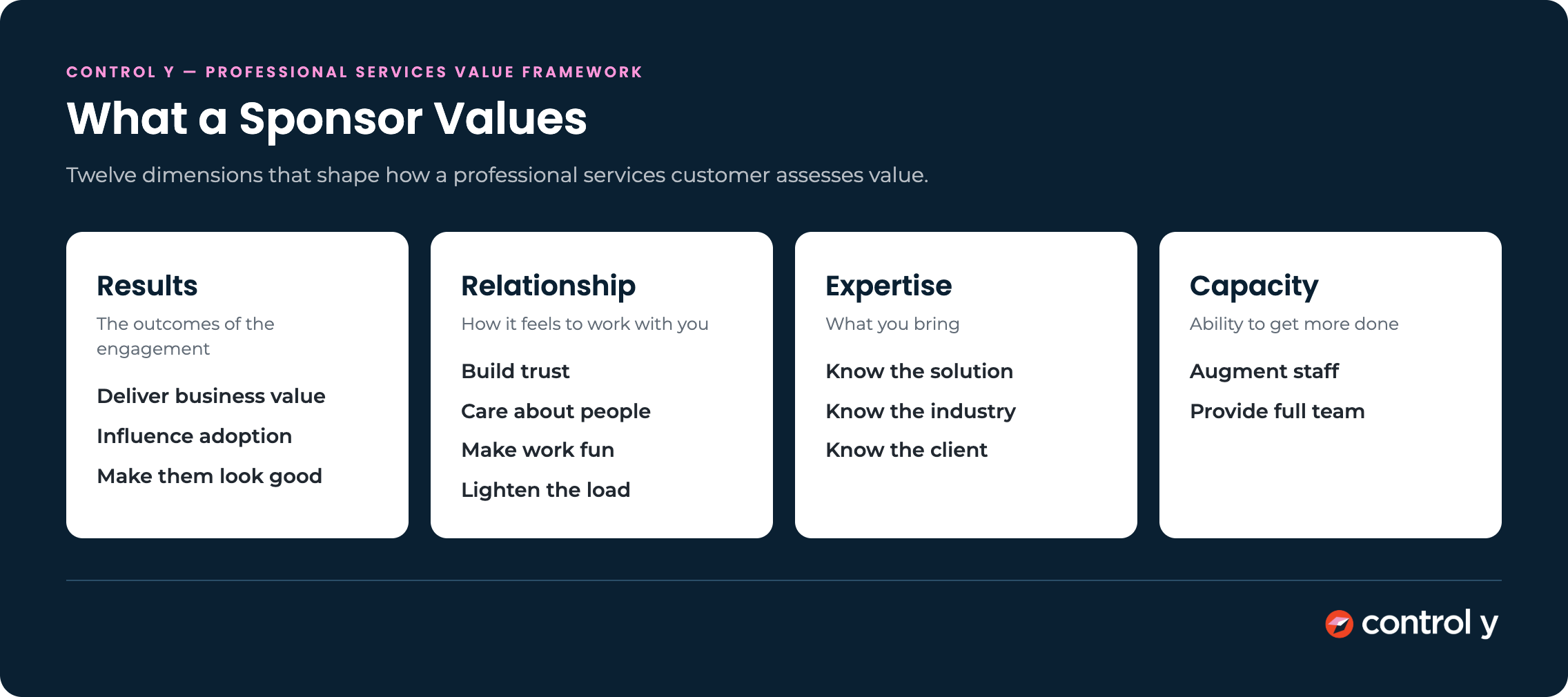
And the good news for professional services leaders is that deliverables are only one dimension of how sponsors assess value. I’m offering a framework that uncovers twelve dimensions of sponsor value.
What Is a Professional Services Sponsor Actually Buying?
Sponsor value shows up across four categories: Results, Relationship, Expertise, Capacity.
This framework reflects the complexity and nuance of how a sponsor perceives value. It explains why a polished deliverable can land flat or a bumpy engagement can lead to a growing partnership.
How AI Is Shifting the Professional Services Value Proposition
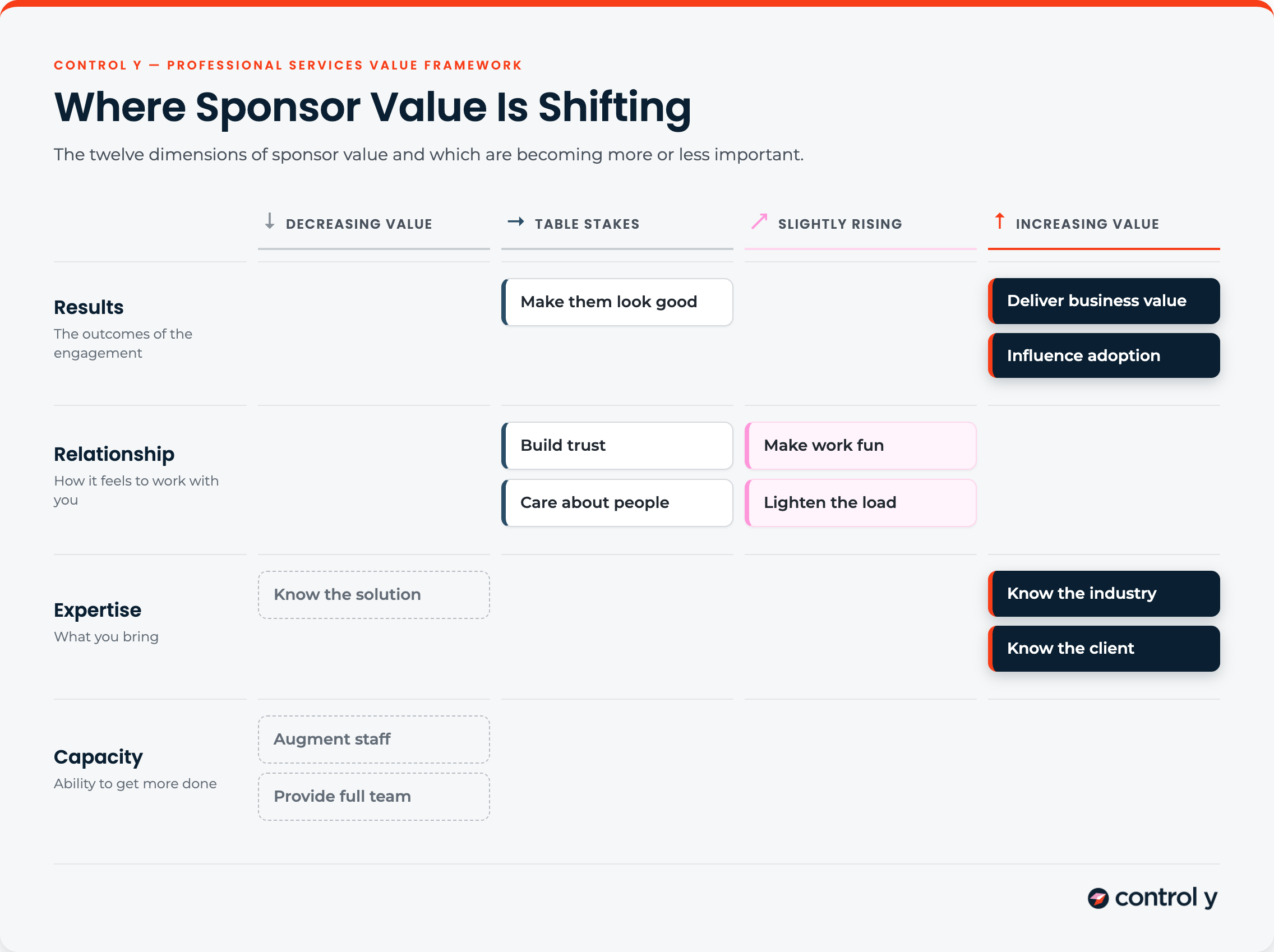
And with the current pace of change, the weight of these dimensions is shifting, making value feel like a moving target. Here is my perspective on how the value of these dimensions is shifting and what it means for professional services leaders.
AI is shifting value from deliverables to business outcomes
In the past, a sophisticated strategy deck, thoughtful solution design, and a well-designed prototype were valuable. The expertise and effort embedded in them helped justify the investment, even if the business impact was never fully realized.
Now the value of “knowing the solution” has been commoditized. If your client can generate a reasonable analysis or prototype in minutes using AI, the deliverable stops being the differentiator. The value isn't in producing the answer anymore. It's in knowing which answer matters and getting the organization to do something with it.
This changes the definition of done. An engagement is finished when the strategy is adopted, not delivered. In an industry that has historically over-indexed on producing answers, there’s an opportunity to differentiate with offerings that turn answers into results.
That requires understanding stakeholders, building buy-in, and creating enough momentum for change to happen. The firms that do this well will have an advantage because adoption is the new bottleneck.
Industry and client expertise are becoming more valuable
AI can tell you how companies in an industry typically approach a problem and give you frameworks, recommendations, and potential solutions. Where it falls short is in the unique dynamics within a company or team. It doesn't know the history behind decisions and all of the unwritten rules that shape how the organization operates. And without this context, the solutions are likely to sit on a shelf.
Companies with industry knowledge and understanding of specific client context will be better positioned to differentiate. These companies will be able to help the sponsor cut through the AI noise and get results faster. The context helps them quickly identify what matters and speak the language of the organization to get things done.
Company Spotlight
Simple Thread is a digital product agency that made the strategic decision over a decade ago to build expertise in the energy industry. Today, they focus exclusively on helping utilities and energy organizations solve grid challenges. Instead of sounding like other digital product agencies and leading with capabilities like software development and data, their brand voice leads with a deep understanding of unique opportunities and challenges in energy transmission and distribution. The result is a value proposition that is harder to commoditize because it’s grounded in context, not just capabilities.
The unit of capacity is changing
The segment of professional services classified as “staff aug” has been hit the hardest.
A team that once took five or seven people to staff may accomplish the same amount of work with two or three AI-enabled people. Clients are expected to do more with less and don’t have the budget to bring on extra resources to augment their teams.
Capacity is relative, though. My hypothesis is that demand decreases in the short term, but recalibrates over time. There will always be an imbalance between what a business wants to do and the team they need to do it, and staff aug is a tool to manage that.
When it does recalibrate, I expect the unit of capacity to change. The question shifts from how many people a firm can provide to how much work that team can accomplish. Professional services companies that can go from selling people to selling the ability to get more done will have a compelling value proposition.
Staff aug revenue may be trending down, but profitability doesn’t have to. A smaller AI-enabled team priced on outcome rather than hours could earn more per engagement than the team it replaced.
The human experience remains a differentiator
People still want to work with people they trust. Fundamentals like doing what you say you’re going to do, communicating clearly, and genuinely caring about people continue to matter.
And because so much work is now done digitally, the value of human interactions has become more important. An engagement that feels like collaboration instead of friction is a breath of fresh air for a sponsor who is inundated with change and tech all day.
Then there’s the dimension that has arguably always been the most important. Make your customer look good. They took a personal risk bringing you in and advocating for the investment. Understanding their personal goals and keeping those at the forefront is still one of the best ways to earn repeat business, and nothing about AI changes that.
When value is shifting, the fundamentals become a competitive advantage.
What This Means for Professional Services Leaders
Measure the results, not the readout. The deliverable is evidence of the work. The business result is the value. If your engagement closes at the recommendations, you’re measuring the wrong moment.
Build influence skills to realize value. Your team needs to know how to turn ideas into action by building alignment, navigating stakeholders, and creating momentum. Ideas without action will join the pile of AI slop.
Lead with a deep understanding of your client. Knowing how to solve a problem is becoming easier to replicate. Knowing how to solve it in a particular client's industry and environment is not.
Treat the fundamentals as a differentiator. Trust, communication, collaboration, and making the sponsor look good have always mattered. And they matter even more in times of massive change.
Ready to Rethink Your Value Proposition?
AI is changing the economics of professional services. Control Y helps professional services leaders adapt their offerings, teams, and leadership approach to create value as the market changes.